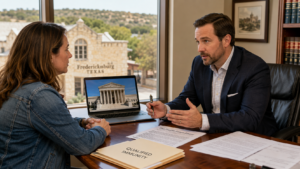


Throughout Gillespie County, estate planning is one of those conversations people tend to push down the road. There’s always another season, another family gathering, another year to get the paperwork in order. Some people assume their spouse will automatically receive everything. Others believe their children will work things out among themselves because the family has always been close. Those assumptions can become expensive. I’ve seen estate disputes turn a period of grief into years of litigation, and in many of those cases, the conflict could have been reduced by clearer planning before death.
Texas law doesn’t wait for a family to decide what feels fair. When someone dies without a valid will, that person dies “intestate,” and Chapter 201 of the Texas Estates Code determines how the estate passes. The statute follows rules based on family relationships and the character of the property. It doesn’t know about a promise made at the kitchen table. It can’t account for the daughter who spent ten years caring for her father, the son who helped build the family business, or the spouse who believed a ranch would remain under his or her control. Without a valid estate plan, those personal expectations may carry far less legal weight than a family expects.
When Texas Intestacy Law Makes the Decision
The consequences of dying without a will can become especially complicated in a blended family.
Under Texas law, if a married person dies intestate and all of that person’s children or descendants are also children or descendants of the surviving spouse, the surviving spouse generally receives the deceased spouse’s share of the community estate. The result changes when the deceased spouse has a child or descendant who isn’t also the child or descendant of the surviving spouse. In that situation, the deceased spouse’s one-half interest in the community estate generally passes to his or her children or descendants.
That distinction can have serious consequences.
Imagine a husband and wife living on property outside Fredericksburg. The husband has two adult children from an earlier marriage. He dies without a will believing his wife will simply continue owning and living on the property as before. Depending on the character of the property and how title is held, his interest may pass in a way neither spouse expected. His widow may suddenly find herself sharing ownership interests with her stepchildren.
Separate property creates another set of inheritance rules. Land owned before marriage or property received by gift or inheritance may be treated differently from community property. That means the answer to “Who gets the ranch?” may depend on facts that aren’t obvious from looking at the deed alone.
For families with meaningful real estate holdings, assuming inheritance will sort itself out is a bad plan.
Why This Matters So Much in Fredericksburg and Gillespie County
Property here often means more than its appraised value. A tract outside Fredericksburg may have been worked by the same family for decades. Acreage near the Pedernales may have passed from parent to child for generations. A family business could sit on land that has appreciated far beyond what anyone expected when it was purchased.
When property passes through intestacy, ownership can become fragmented among several heirs. Each person may receive an undivided interest rather than a neat physical portion of the property. One heir may want to keep the land. Another may need cash. Someone living in Houston may have a completely different view of the property than the relative who has lived on it for thirty years.
That’s where trouble starts.
Disputes over maintenance expenses, taxes, improvements, rental income or a possible sale can turn relatives into opposing parties. In some circumstances, a co-owner may seek partition of the property through the courts. The family then spends money litigating the future of an asset that could have been addressed directly in an estate plan.
Land preservation often begins with paperwork long before anyone steps inside a courthouse.
Having a Will Doesn’t Automatically Prevent a Fight
A properly prepared will provides far more direction than intestacy, but a document labeled “Last Will and Testament” isn’t automatically immune from attack.
Texas law sets requirements for creating and executing wills. With certain exceptions, a written will must be signed by the testator or by another person acting in the testator’s presence and at the testator’s direction. The will must also be witnessed by at least two credible witnesses who meet the statutory requirements. Texas recognizes an exception for holographic wills written entirely in the testator’s handwriting.
Capacity matters too. The Texas Estates Code provides that a person must be of sound mind and otherwise legally eligible to execute a will.
Even when a document appears valid on its face, litigation may follow. An heir may allege that the person signing the will lacked testamentary capacity. Another may claim a signature was forged. A dispute can center on whether someone exerted undue influence over an elderly or vulnerable person. Fraud allegations may arise when family members believe the testator was deceived about what he or she was signing.
Texas probate procedure allows an interested person to oppose issues in a probate proceeding and present witnesses and evidence. Contested probate matters can also be tried to a jury.
These cases get personal fast.
A son may accuse a sibling of isolating a parent. A caregiver may be accused of manipulating someone who depended on them. Medical records can become evidence. Financial transactions that seemed mundane at the time may receive microscopic scrutiny years later. Text messages, emails and handwritten notes can suddenly become exhibits.
Once a family reaches that stage, the dispute isn’t only about property anymore.
Undue Influence and Capacity Can Become the Center of the Case
Some of the hardest probate cases involve wills signed late in life.
A person can be elderly, physically frail or medically ill and still possess the mental capacity required to make a will. Age by itself doesn’t answer the legal question. The circumstances surrounding execution matter.
Suppose an older ranch owner changes a longstanding estate plan months before death and leaves most of the property to one child. The other children may question why. If that child had recently taken control of the parent’s finances, restricted access to other relatives or participated heavily in arranging the new estate documents, litigation may follow.
The resulting inquiry can reach far beyond the will itself. Lawyers may examine medical records to understand cognitive condition around the date of execution. Witnesses may be questioned about conversations and behavior. Bank records can show whether unusual transfers occurred. The drafting attorney’s file may become highly relevant to determining whether the client acted independently and understood the estate plan.
Good estate planning anticipates that possibility.
When circumstances create a foreseeable risk of a future contest, careful documentation during the planning process can matter enormously. That could mean detailed attorney notes, independent conversations with the client or other appropriate measures based on the situation. In some cases, obtaining a contemporaneous medical assessment of capacity may help create evidence that becomes significant years later.
The Anna Nicole Smith Estate Litigation Shows How Far These Cases Can Go
Earlier in my career, I worked on litigation involving the estate of Texas oil executive J. Howard Marshall II and his widow, Vickie Lynn Marshall, better known as Anna Nicole Smith. The dispute became one of the most publicized estate battles in modern American legal history.
Marshall’s wealth was closely tied to a substantial ownership interest in Koch Industries. Court records later described interests controlled through Marshall entities representing roughly 14.7 percent of Koch Industries in 1995. Marshall’s estate plan largely benefited his son, E. Pierce Marshall, while Vickie Lynn Marshall claimed her husband intended to provide for her through a separate gift or trust.
The litigation spread through Texas probate proceedings, federal bankruptcy litigation and appellate courts. It eventually reached the United States Supreme Court more than once. One Supreme Court proceeding addressed the scope of the federal “probate exception.” Years later, another examined the constitutional authority of bankruptcy courts to enter final judgments on certain state-law counterclaims.
The numbers were enormous, but the underlying conflict was familiar. What did the deceased person intend? Were those intentions properly documented? Did someone interfere with them? Which court had the authority to decide the dispute?
Most Gillespie County families will never litigate over a billion-dollar fortune. They don’t need to. A fight over a $700,000 ranch, a family home or a closely held business can be financially devastating to the people involved.
The lesson scales down very easily.
A Will Has to Make It Through Probate
Signing a will is a major step, but the document ultimately has to function when the person who signed it is no longer here to explain what was intended.
Texas law provides that a will generally isn’t effective to establish title to or possession of property disposed of through the will until it has been admitted to probate. Texas also generally imposes a four-year period after death for presenting a will for probate, subject to statutory exceptions involving an applicant who wasn’t in default for failing to present it earlier.
That’s another reason families need to know that estate documents exist and where they’re kept.
A beautifully drafted will sitting undiscovered in a safe deposit box can create its own set of problems. So can an unsigned draft found on a computer. Old wills that were never properly revoked may raise questions. Multiple versions can fuel arguments over which document reflects the decedent’s final intent.
Estate planning needs to be treated as an active legal process, not a document you sign once and forget for thirty years.
Planning Now Can Make a Future Contest Harder
No attorney can guarantee that a will won’t be challenged. Anyone with the legal standing and factual basis to bring a claim may attempt to do so.
What careful planning can do is reduce ambiguity.
A professionally prepared estate plan can clearly identify beneficiaries and explain how property should pass. Proper execution helps eliminate avoidable questions about whether statutory requirements were followed. Reviewing a plan after major life events can keep an outdated document from controlling property years after circumstances have changed.
Blended families deserve special attention. So do family-owned businesses and substantial real estate holdings.
A second marriage combined with children from a prior relationship is exactly the kind of situation where assumptions can collide with Texas intestacy law. The same is true when one child works in a family business while the others don’t, or when one heir wants ranch land preserved while another expects an inheritance that can be converted to cash.
Those conversations may be uncomfortable.
Court is worse.
Your Legacy Should Be Decided by You
Fredericksburg is a community where family land can carry decades of history. Businesses often have names tied directly to the people who built them. Homes, ranches and inherited acreage can have emotional value that no county appraisal will ever capture.
Texas law provides a system for distributing property when someone dies without a will. That system has to exist. It shouldn’t be mistaken for a personalized estate plan.
If you don’t make the decision, the Texas Estates Code will make many of those decisions for you.
A thoughtful estate plan gives your family something valuable during an already difficult time: direction. It tells them what you wanted when you’re no longer there to settle the argument yourself.
For families with land, a business, children from different relationships or concerns about a future inheritance dispute, waiting until “later” can create exactly the problem planning was meant to prevent.
The Powell Law Firm assists clients in Fredericksburg and across Texas with probate disputes, contested estates and litigation involving wills and inheritance. When questions arise over the validity of a will, the conduct of an heir or the proper ownership of estate property, the earlier those issues are examined, the better positioned a family may be to protect its rights.